


.png)
The Progress Behind the Pink: What’s Next in Breast Cancer Care
Over 1,000 women will be diagnosed with breast cancer today, and almost 400,000 women will be diagnosed with breast cancer this year. Breast cancer is the second most
October 21, 2026

The FDA Opened a Faster Door for Rare Disease.
Payers Still Control What's Behind It. FDA is creating new flexibility for individualized therapies. But approval and access answer different questions — and developers need to plan for both from the start.
In early 2025, an infant named KJ Muldoon became the first person in the world to receive a CRISPR base-editing therapy built for his own mutation.
KJ had a severe form of CPS1 deficiency, an ultra-rare urea cycle disorder that kills roughly half the infants who have it. There was no time for a trial, and no population big enough to run one on. So a team at Children's Hospital of Philadelphia and Penn designed, manufactured, and delivered a therapy made specifically for him in about six months. He lived.
The result was historic: the first personalized CRISPR treatment designed for a single patient and delivered on a timeline measured in months rather than years.
Less than a year later, FDA began turning the lessons from cases like KJ's into a regulatory framework.
What the Framework Actually Says
On February 23, 2026, kicking off Rare Disease Week, CBER and CDER jointly released draft guidance titled Considerations for the Use of the Plausible Mechanism Framework to Develop Individualized Therapies That Target Specific Genetic Conditions with Known Biological Cause. It formalizes a concept FDA leadership floated in the New England Journal of Medicine in November 2025: for ultra-rare genetic disease, an individualized therapy can support full approval on the strength of a scientifically plausible mechanism of action, in cases where a randomized controlled trial simply isn't feasible.
The guidance speaks directly to genome editing and RNA-based therapies such as antisense oligonucleotides, while leaving the door open to other modalities that address the underlying cause of disease.
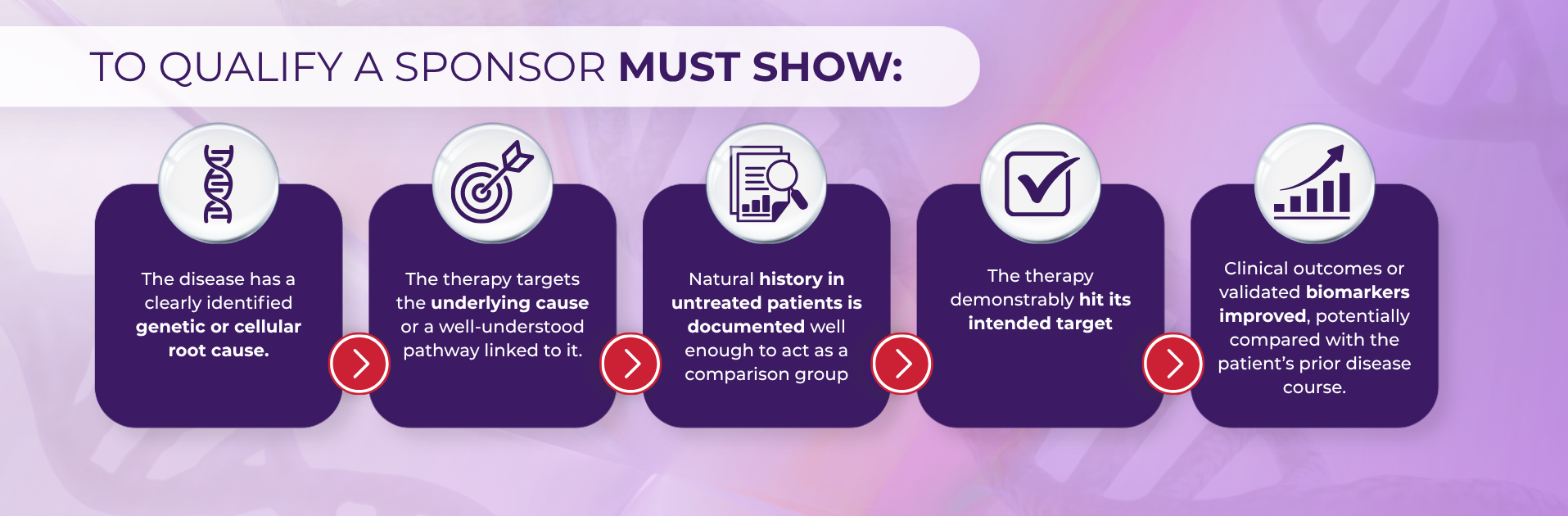
To fit the framework, a program generally needs to establish that:
• The disease has a clearly identified genetic or molecular root cause
• The therapy targets that root cause, or a well-characterized pathway downstream of it
• Natural history in untreated patients is documented well enough to serve as an external control
• The therapy demonstrably engaged its intended target
• Clinical outcomes or validated biomarkers improved — potentially measured against the same patient's own prior disease course
• The therapy can be manufactured to appropriate regulatory quality standard
This lands alongside a broader shift the agency signaled days earlier: that a single adequate and well-controlled study plus confirmatory evidence can constitute substantial evidence of effectiveness, rather than the two-trial expectation sponsors have planned around for decades. Two separate policy moves, pointing the same direction.
None of this is the FDA asking for less proof. It's the FDA accepting a different kind of proof — and shifting more of the burden to the back end. Expect post-marketing requirements and commitments, long-term follow-up (especially for genome editing), and, for anything cleared on an accelerated basis, confirmatory trials with real consequences. The agency has been explicit that it can use expedited withdrawal authority when sponsors don't deliver.
Part of a Bigger Strategic Shift
The Plausible Mechanism Framework is not an isolated regulatory experiment. It's one output of a much broader effort to rethink how rare disease gets regulated:
• The Rare Disease Innovation Hub has committed the agency to advancing regulatory science for small populations — novel endpoints, biomarkers, better trial designs, real-world evidence methods.
• The RISE workshop series, run with Duke-Margolis, spent 2025 and early 2026 building the evidentiary record this guidance draws from, including a November 2025 session focused specifically on individualized therapies.
• A Rare Disease Policy and Portfolio Council gives CBER and CDER a standing forum to align on individual cases — a structural change in how both centers handle ultra-rarereview, not a one-off.
The direction is clear: FDA is building infrastructure around regulatory flexibility in rare disease, rather than simply granting exceptions one program at a time.
Promise, With Real Open Questions
That flexibility also creates important questions.
Policy experts have raised issues around how individualized products should be defined when related therapies differ by genetic variant, how much modification can occur before a therapy becomes a different product requiring its own evidence package, and what manufacturing standards should look like for products that may effectively be made one patient at a time.
Writing in JAMA Health Forum in March 2026, former FDA Commissioner Scott Gottlieb and former CDER Office of New Drug Policy director Maarika Kimbrell called the framework a meaningful step that acknowledges biology is personal — then pressed the agency to answer some basic questions before finalizing it. Are different genetic variants of a therapy bundled under one approval, or treated as separate products? Where exactly is the line between adapting a therapy for a new patient and creating a different product that needs its own evidence? What are the manufacturing expectations for a product that is, by design, made one patient at a time? A two-part Health Affairs Forefront series raised parallel concerns, including how the agency should structure long-term follow-up registries across related therapies.
Sponsor-side commentary has focused on fit: how this framework interacts with existing pathways like accelerated approval and orphan drug designation, and how much regulatory certainty a company can actually count on going in. And it's worth remembering that even amid all the flexibility rhetoric, the FDA rejected several rare disease applications in 2025. Flexibility on paper doesn't automatically mean approvals inpractice.
The comment period closed on April 27, 2026. The guidance is still in draft. That matters because companies are making development and investment decisions today against anevidence framework that is still evolving.
Where the Real Gap Opens Up: Payers
This is where the implications extend well beyond FDA.
Regulators and payers are not the same audience, and they are not moving at the same speed. The FDA's flexibility governs how evidence gets generated. It says nothing about how much evidence payers will want.
ISPOR's 2026–2027 Top 10 HEOR Trends report ranks innovative therapies at #5 and notes that many new treatments, particularly in rare disease, struggle to gain market access because payers and health technology assessment bodies want data above and beyond what regulators require for approval.
A 2025 Cencora survey of 19 senior payer decision-makers puts numbers on it: 79% pointed to uncertainty about long-term efficacy and safety as a driver of reimbursement difficulty, and 74% to high upfront cost. More than half — 58% — said they were moderately to extremely likely to cover cell and gene therapies under miscellaneous billing codes. That sounds like a coding technicality until it becomes up to a year of access delay after a therapy is already approved.
Traditional value assessment wasn't built for this either. Cost-effectiveness models designed around large populations and years of comparative data don't map cleanly onto a therapy made for one patient and measured against natural history instead of a placebo arm. Payers are left asking a question the regulatory package was never designed to answer: does the effect hold, and is it worth the price if it doesn't?

The Reimbursement Model Will Need to Evolve Too
CMS's Cell and Gene Therapy Access Model offers an early glimpse of one potential direction. Newer payment models — like CMS's Cell and Gene Therapy Access Model, which ties reimbursement to outcomes — point toward where this is headed, but they remain narrow in scope. And the Plausible Mechanism Framework requires payers to cover exactly nothing. It opens a regulatory door. It says nothing about what's waiting on the other side.
The model initially focuses on gene therapies for sickle cell disease in Medicaid and uses outcomes based agreements that tie aspects of payment to patient outcomes.
Its scope today is narrow. But the underlying concept is highly relevant to individualized rare disease therapies: when uncertainty cannot be eliminated before launch, manufacturers and payers may need mechanisms to manage that uncertainty after treatment.
Individualized therapies create an even harder version of the problem.
How do you structure an outcomes based agreement when the treated population may be measured in single digits? What constitutes treatment failure? How long should durability be measured? Who tracks the patient if coverage changes? And how should payment risk be allocated when the clinical evidence continues to mature for years after treatment?
The Plausible Mechanism Framework answers none of those questions.
It opens a regulatory door. It does not determine what happens on the other side.
Closing the Gap
Faster, more flexible FDA pathways are good news. More ultra-rare and individualized therapies will reach approval, and sooner. But approval isn't the finish line. It's the opening of the payer conversation — a different clock, different evidence, a different audience.
The companies that get ahead of this will treat market access as part of regulatory strategy from the start, not something that begins after the BLA is filed. In practice, that means four things:
Design the natural history strategy and real-world evidence infrastructure that does double duty — satisfying the FDA's external control requirements and answering payers' durability questions from the same dataset.
Bring in HEOR and payer evidence planning before the pivotal evidence package is designed. With timelines this compressed, there often isn't a second chance; once the eligible patient population has been treated, the evidence you have is the evidence you get.
Make the post-market evidence plan part of the access strategy — before they ask for it. Registries, durability endpoints, patient reported outcomes, healthcare utilization, retreatment, and longer term safety should be designed not only around regulatory commitments, but around future coverage reassessment and potential outcomes based agreements.
Engage with payers 12 to 18 months before approval, not after. Starting payer conversations 12 to 18 months before approval is not simply about educating the market. It is an opportunity to pressure test the evidence plan while there is still time to close gaps.
That last distinction matters.
Early payer engagement is not just launch preparation. It is evidence strategy.
FDA's Plausible Mechanism Framework could fundamentally change what is possible for patients with ultra rare genetic disease. But it also makes one thing increasingly clear: FDA flexibility does not eliminate the evidence burden. It redistributes it. Getting through the regulatory door faster will only matter if patients can get through the access door on the other side.
MEYA Health helps rare disease developers build that bridge early — connecting regulatory evidence strategy, HEOR, payer evidence needs and launch planning before access gaps become launch barriers.
If your team is navigating the Plausible Mechanism Framework or planning a rare disease launch, let's talk.
— The MEYA Health Team
Ready to Navigate What's Next?
MEYA Health partners with pharmaceutical manufacturers to develop evidence-driven market access strategies, payer engagement frameworks, and value communications that reflect today's evolving reimbursement landscape.
As the environment continues to shift, the questions are becoming more complex:
The organizations that succeed will be those that anticipate change rather than react to it.
Schedule a conversation with the MEYA Health team to explore what these shifts mean for your market access strategy.
We continuously explore innovative approaches to help you navigate the complexities of the healthcare payer landscape. Download the Ultimate Guide to Market Access to learn more.


.png)
.png)