AI Literacy vs. AI Dependency: The Educational Divide We Need to Address
AI Literacy vs. AI Dependency: The Educational Divide We Need to Address
Artificial intelligence has moved from emerging technology to everyday utility with remarkable speed. By the first quarter of 2026, generative AI was being used by an estimated 17.8% of the world's working age population, up from 16.3% in the second half of 2025. The divide is already visible: adoption reached 27.5% in the Global North compared with 15.4% in the Global South.
In healthcare, AI now touches everything from biomedical research and drug development to clinical decision support, evidence generation, prior authorization, and claims processing. As AI becomes more embedded in how we work, learn, and make decisions, the question is no longer whether we will use it. It is how we will use it without surrendering the judgment we are responsible for.
That distinction is increasingly important. AI literacy means understanding how to use AI strategically and effectively while retaining the ability to question, evaluate, and validate what it produces. AI dependency begins when we allow the technology to take over the thinking, problem solving, or decision making we are expected to do ourselves.
Education researcher Thomas K.F. Chiu and colleagues describe AI literacy as more than technical proficiency. Their framework distinguishes knowing about AI from being able to apply that knowledge effectively, with an emphasis on understanding, confidence, self-reflection, and responsible use. In other words, AI literacy is not simply knowing how to write a good prompt. It means understanding what an AI system can and cannot do, recognizing limitations and bias, and being able to evaluate its output rather than simply accept it.
Dependency develops more quietly. Recent research is beginning to distinguish between autonomous cognitive offloading, in which AI acts as a scaffold for a person's own thinking, and dependent cognitive offloading, in which the user delegates core thinking to the technology. A 2026 study of university students and early career knowledge workers found that these are meaningfully different patterns of AI use, with dependent offloading associated with reduced cognitive agency, while autonomous use preserves the user's role as the active thinker.
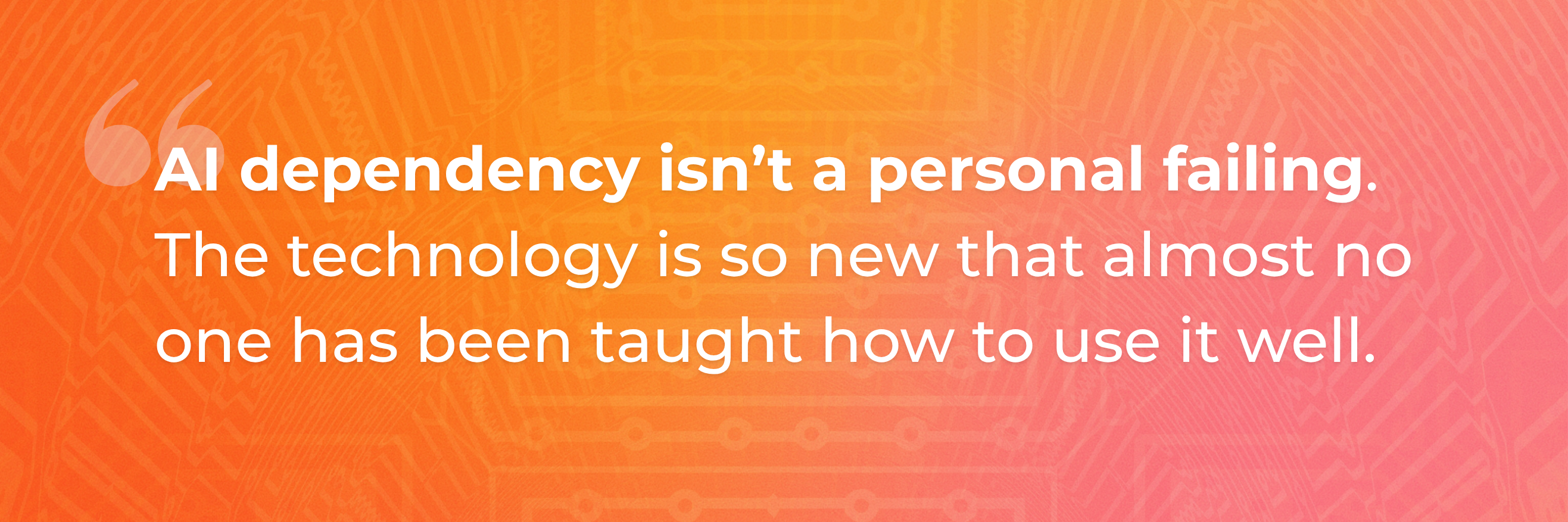
That distinction matters because AI dependency is not necessarily a personal failing. The technology has arrived faster than most institutions have developed the education, norms, and safeguards needed to use it well. The problem is not that people use AI. The problem is that many people are learning to use it without being taught how to remain accountable for what it produces.
The debate around AI often collapses into good versus bad. That's the wrong axis.
The better questions are:
What are we using AI for?
What cognitive work are we asking it to perform?
What responsibility remains with the user?
Like any powerful tool, AI can support learning or undermine it, sharpen judgment or replace it. In healthcare, those questions play out at every level, from patients to physicians to payers to the people developing the evidence that ultimately determines how new treatments are valued and accessed.
Patients are already asking
Patients are already turning to AI for health information at an enormous scale. OpenAI reports that more than 300 million people each week ask ChatGPT health related questions, ranging from understanding laboratory results and preparing for appointments to making sense of what a physician has said. In July 2026, OpenAI also launched Health in ChatGPT in the United States, allowing users to connect supported medical records and Apple Health data to have more personalized conversations about their health.
This is a generative upgrade to the familiar "Dr. Google" phenomenon. But accessibility and reliability are not the same thing.
The important question is not whether patients will use AI for health information. They already are. It is whether they understand when AI can help them prepare, understand, and ask better questions, and when it should not be treated as a substitute for clinical judgment.
Privacy matters here, too. Consumers need to understand what information they are sharing, what protections apply to that information, and whether the platform they are using is subject to healthcare privacy requirements. HIPAA protections, for example, apply to covered health plans, healthcare providers, and their business associates, rather than automatically applying to every consumer technology platform simply because health information is involved.
AI literacy for patients therefore does not mean telling people not to use AI. It means teaching them how to use it responsibly:share thoughtfully, question confidently, verify important information, and know when to move from the chatbot to the clinician.
Physicians are already using it
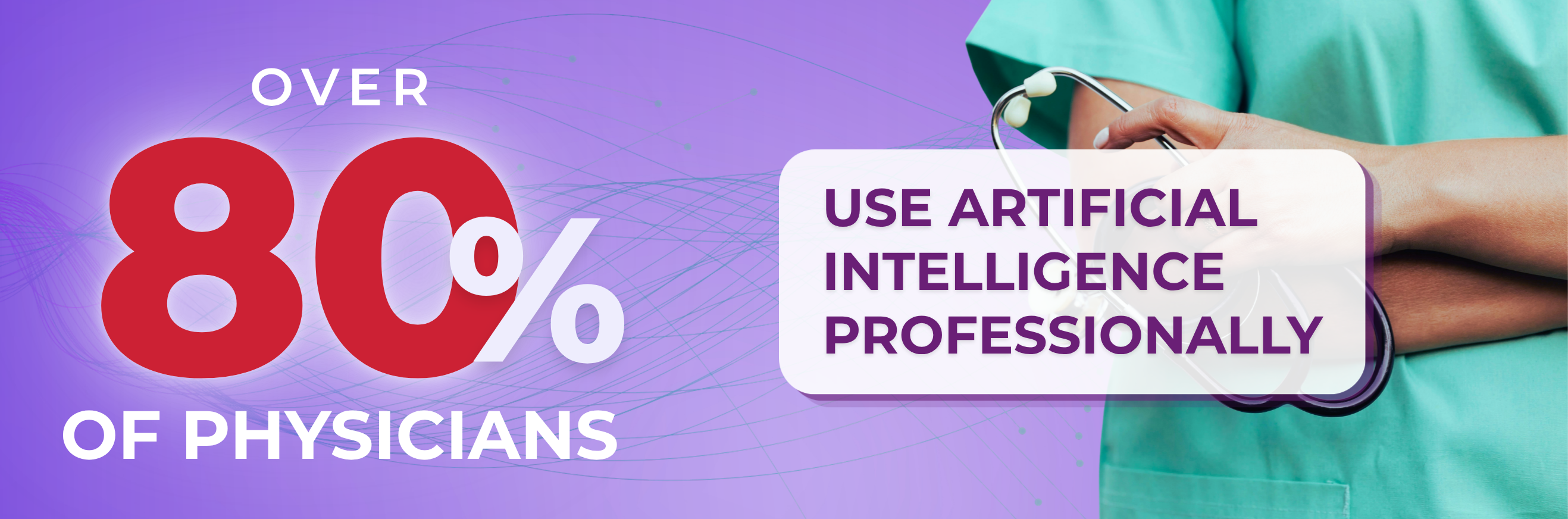
Patients aren't the only ones. More than 80% of physicians now use AI professionally. The American Medical Association's 2026 survey found that 81% of physicians reported using AI in practice, compared with 38% in 2023.The most common uses include summarizing medical research and standards of care, creating discharge instructions and care plans, documentation, chart summaries, and patient communications.
Used well, these tools can reduce administrative burden and help clinicians synthesize information more efficiently. But dependency looks very different.
It looks like accepting an AI generated differential diagnosis without independently working through the case. It looks like allowing a generated summary to replace review of the underlying evidence. It looks like assuming that a confident answer is a correct one.
AI literacy does not mean avoiding these tools. It means understanding that an LLM's confidence is not clinical evidence, and fluency is not accuracy.
The most valuable clinical judgment may increasingly be knowing when AI is useful, when its output needs to be challenged, and when the right next step is to stop asking the model and start asking a healthcare professional.
The stakes rise with payers
The same principle applies to payers, where AI can influence decisions that directly affect whether, how, and when patients receive care.
AI and machine learning are already being incorporated into healthcare payment and utilization processes. CMS's 2026 WISeR model, for example, uses enhanced technologies including AI and machine learning alongside human clinical review to support prior authorization and payment review for selected services in Original Medicare. CMS explicitly requires clinician involvement in coverage determinations.
That distinction is important.
AI can support a coverage decision. It should not become a substitute for the judgment required to make one.
The risk is automation bias: a human reviewer may give disproportionate weight to an algorithmic recommendation simply because it appears objective, efficient, or data driven. The American Medical Association has raised specific concerns about AI use in prior authorization and has called for transparency, clinical criteria, qualified human review, and safeguards against algorithmic discrimination.
Imagine an AI system flags a prior authorization request as unlikely to meet medical necessity criteria. A reviewer accepts the recommendation without examining the underlying record. The patient may experience a delay or denial not because AI was incapable of helping, but because the human being responsible for the decision failed to interrogate the output.
A human in the loop only helps if that human is AI literate.
The same issue exists upstream in market access and HEOR
The implications extend into the research and market access work that determines how treatments are evaluated, valued, and ultimately accessed.
AI can accelerate systematic literature reviews, synthesize evidence, identify patterns in complex datasets, support trial recruitment, and assist with health economic modeling. These capabilities could be particularly valuable in rare diseases, where patient populations are small and evidence is often limited.
But the most interesting question is not whether AI can do the work. It increasingly can.
The question is whether the person using it knows enough to recognize when the work is wrong.
A 2024 study published in PharmacoEconomics Open provides a useful example. Researchers asked GPT-4 to recreate two published health economic models, one in non-small cell lung cancer and one in renal cell carcinoma. They ran each model 15 times and compared the AI generated models with the original analyses. GPT-4 reproduced the NSCLC model with very high accuracy, while the RCC model required human intervention to simplify part of the model. When the generated models were error free, the incremental cost effectiveness ratios were reproduced to within 1% of the published analyses.
That is not an argument against AI.
It is an argument for AI literacy.
The researchers did not simply ask AI to build the models and accept the first answer. They replicated the process, compared outputs against known results, identified where human intervention was required, and validated the results.
That is what responsible AI use looks like.
Dependency would look very different: asking AI to build an economic model, synthesize the evidence, or draft a value dossier and then accepting the result without checking the sources, assumptions, calculations, or underlying methodology.
In market access, that distinction is consequential. A plausible but incorrect analysis can influence a value story, a payer submission, a budget impact estimate, or ultimately a reimbursement decision.
The divide is not simply about age or access
These risks are not distributed evenly.
Younger adults are among the most active chatbot users, including for information seeking, work, and health advice. Older adults may face different risks, including greater vulnerability to AI-enabled misinformation and scams. And access itself is becoming a new source of inequality: global AI adoption is substantially higher in wealthier countries than in lower income countries.
But the deeper divide may not be between people who have access to AI and those who do not.
It may be between people who know how to use AI without surrendering their own judgment and people who do not.
That is an educational divide.
Closing the literacy gap
Closing it will require more than teaching people how to prompt.
Medical, nursing, and pharmacy schools can teach students to interrogate AI output in much the same way they are taught to critically appraise a clinical study.
Healthcare organizations can build validation, documentation, and escalation practices into AI-enabled workflows.
Employers and professional societies, including those in HEOR and market access, can teach professionals how to evaluate AI generated evidence, models, summaries, and recommendations rather than treating AI proficiency as synonymous with AI literacy.
And patients can be given practical guidance on what information to share, how to verify health information, and when AI should give way to a healthcare professional.
Importantly, this approach is already reflected in emerging regulatory and evidence generation guidance.
The FDA's January 2025 draft guidance on AI used to support regulatory decision making for drugs and biological products proposes a risk-based credibility assessment framework tied to the specific context in which an AI model is being used.
The EMA's 2024 reflection paper addresses AI and machine learning across the medicinal product lifecycle and emphasizes the need to manage risks related to reliability, bias, transparency, and patient safety.
NICE's position statement on AI in evidence generation similarly emphasizes demonstrable value, transparency, explainability, bias, human oversight, and appropriate reporting when AI methods are used in HTA evidence generation.
And WHO's guidance on large multimodal models emphasizes human autonomy, accountability, transparency, appropriate testing, and the involvement of affected stakeholders in the design and deployment of AI in health.
Taken together, these principles point toward a practical definition of AI literacy:
Know what the tool can do.
Know what it cannot do.
Understand the context in which you are using it.
Validate what matters.
Remain accountable for the final judgment.
The goal is not less AI. It is better use of AI.
The goal was never to build a world of people who refuse to use AI. It is to build one where people use it without surrendering the judgment that makes their work matter.
In healthcare and market access, that judgment is not incidental. It is the ability to question an assumption, recognize a flawed model, challenge an unsupported conclusion, understand the patient behind the data, and know when a confident answer is wrong.
AI can sharpen those skills.
It can also quietly replace them.
The difference is not in the technology. It is in the literacy of the person using it.
That makes AI literacy more than a technical skill. It is a professional competency, an educational imperative, and increasingly, a patient safety issue.
We should not be teaching people to use AI instead of thinking. We should be teaching them how to think better with AI.
MEYA Health partners with pharmaceutical manufacturers to develop evidence-driven market access strategies, payer engagement frameworks, and value communications that reflect today's evolving reimbursement landscape.
As the environment continues to shift, the questions are becoming more complex:
Is your value story tailored for Medicare, Medicaid, and commercial payers—or are you relying on a one-size-fits-all approach?
Are your payer engagement strategies prepared for evolving coverage criteria, pricing pressures, and utilization management?
How will you expand patient access while maintaining strong relationships with payers, employers, and health systems?
The organizations that succeed will be those that anticipate change rather than react to it.
Schedule a conversation with the MEYA Health team to explore what these shifts mean for your market access strategy.





.png)


.png)
.png)